
Criminal Records in Placer County
Three agencies create the bulk of these files. The Placer County Sheriff's Office books people into jail at the Auburn Jail on Richardson Drive and the South Placer Jail on Go For Broke Road in Roseville. Local police, the California Highway Patrol, and federal partners also make arrests in the county. Once a person is booked, the Sheriff's records team logs the arrest, charges, and identifiers. The Placer County District Attorney, led by Morgan Gire, reviews each case and decides whether to file charges. The DA office sits at 10810 Justice Center Drive, Suite 240, Roseville, CA 95678, and can be reached at 916-543-8000.
The Superior Court of California, County of Placer opens a criminal case file when the DA files a complaint or information. From that point on, the Clerk of the Superior Court holds the official record. Filings, minute orders, plea forms, sentencing notes, and probation reports all live in that file. Placer criminal case numbers begin with 62. Most adult criminal files are public, but the documents inside them are courthouse-access only for the public under California Rule of Court 2.503(c). Online viewing of full criminal documents is limited by that rule.
An arrest record is not the same as a criminal court record. An arrest record is born at booking and lives with the law enforcement agency. A criminal court record begins when charges are filed and lives with the court. A conviction record is a third layer, set when a judge or jury reaches a verdict or a plea is entered. Each layer has its own access rules. Each can be sealed, dismissed, or kept open in different ways.
How to Search Placer County Criminal Records
The official starting point is the Placer eCourt public portal. It covers criminal, civil, traffic, family, and probate cases. No login is needed to search basic public case info. To pull arrest data outside of court filings, use the Sheriff's 10 Day Arrest Log and the In-Custody Report posted on the county View page. The court's Criminal Division page lists filing rules, fee waivers, and the criminal calendar.
The court site itself has a helpful overview of how criminal matters flow through the system, from arraignment through sentencing. The screenshot below shows the official division page.
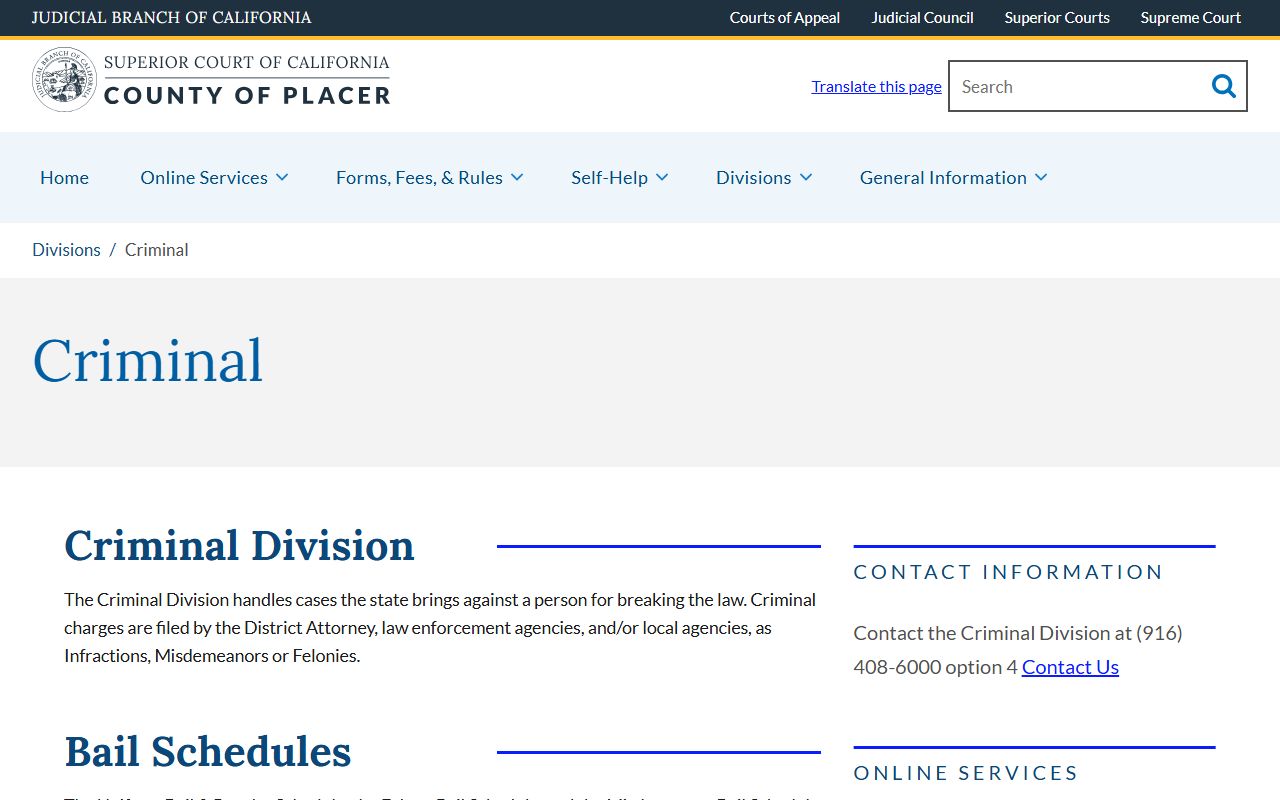
That page links to the case management portal, judicial assignments, and forms used in the Criminal Division. Use it before any third-party tool.
- Open the eCourt public portal and accept the terms. Pick "Search for a Case" under Public Services. No account is needed for a basic name search.
- Choose Case Search-EXT. Enter the last name and first name, or the case number. Criminal case numbers start with 62 and seven digits, so the format looks like 62-0000001.
- Set a filing date or date range. The filing date is required. If you do not know it, pick a wide range and narrow down. A search will miss a case if the filing date falls outside the range.
- Click Search. Read the case summary and the register of actions. The list shows each filing, hearing, plea, and order in date order.
- For full criminal documents, plan a courthouse visit. Rule 2.503(c) keeps most criminal documents off the public portal. Parties and counsel can request remote access through a court account.
- To match the case with an arrest, pull the 10 Day Arrest Log from the Sheriff. Cross-check the name, date, and charges. The log goes back ten days, not further.
For deeper case history that crosses county lines, the California Department of Justice runs a state-level rap sheet program. The California DOJ Record Review lets a person request their own criminal history through Live Scan fingerprints. That report is the closest thing to a statewide criminal record for an individual.
Arrest Records vs Criminal Court Records
The arrest record and the court record are two different files. An arrest happens on the street or at a scene. Booking happens at the jail. The Sheriff's record starts there. A court file does not exist yet at that point. The DA must review the case and file a complaint or information first. Some arrests never lead to a court case. Some arrests turn into long, complex cases that fill hundreds of pages in the clerk's file.
| Arrest Record | Criminal Court Record | |
|---|---|---|
| Source | Sheriff or arresting police agency | Superior Court Clerk |
| Created When | Booking at jail | DA files complaint or information |
| Main Contents | Booking sheet, charges, mugshot, identifiers | Pleadings, motions, plea forms, minute orders, disposition |
| Where To Find | 10 Day Arrest Log, In-Custody Report | eCourt portal, courthouse terminals |
| Online Access | PDF reports, public | Index and docket public; documents in person under CRC 2.503(c) |
| Number Format | Internal booking ID | Case number begins with 62 |
Both files can be searched, but the gaps matter. The 10 Day Arrest Log only covers ten days. The court file lasts as long as the case is on the docket plus the retention period. A person arrested in Auburn last year will not appear on today's arrest log. They may still appear in the eCourt portal if charges were filed.
Charges vs Convictions
Being charged is not the same as being convicted. A charge is a formal claim by the state. A conviction is a finding of guilt, by plea or by verdict. The gap between the two can be wide. Many charges end in dismissal, reduction, or acquittal. A clean search of a person's name might still pull up old charges that never led to a conviction. Read each line of the docket before you draw a line on a person.
| Charge | Conviction | |
|---|---|---|
| Stage | Accusation by the DA | Verdict or accepted plea |
| Burden of Proof | Probable cause to file | Beyond a reasonable doubt at trial |
| Who Decides | Prosecutor | Judge or jury |
| Public Record | Yes, in the case file | Yes, in the case file |
| Outcome Possible | Dismissed, reduced, refiled, or set for trial | Probation, jail, prison, fines, or program |
| Relief | May be sealed if no conviction follows under Penal Code 851.91 | May be dismissed under Penal Code 1203.4 after probation |
One quick test helps. Look at the disposition line in the court file. If the case shows "dismissed," "acquitted," or "not guilty," there is no conviction. If the case shows "guilty plea," "no contest plea," or "guilty verdict," there is a conviction. A pending case has neither yet.
Sealed vs Expunged Records
California uses both terms, but they do not mean the same thing. Sealing hides a record from most public view. Expungement, called dismissal relief in California, does not destroy a record. It changes how that record is used and reported. A 1203.4 dismissal still leaves the case in the system. The disposition changes to dismissed for many public uses. Some uses, such as state licensing or future prosecution, still see the prior case.
The state agency overview of arrest sealing under Penal Code 851.91 sits on the official California legislature site. The image below shows the statute text.
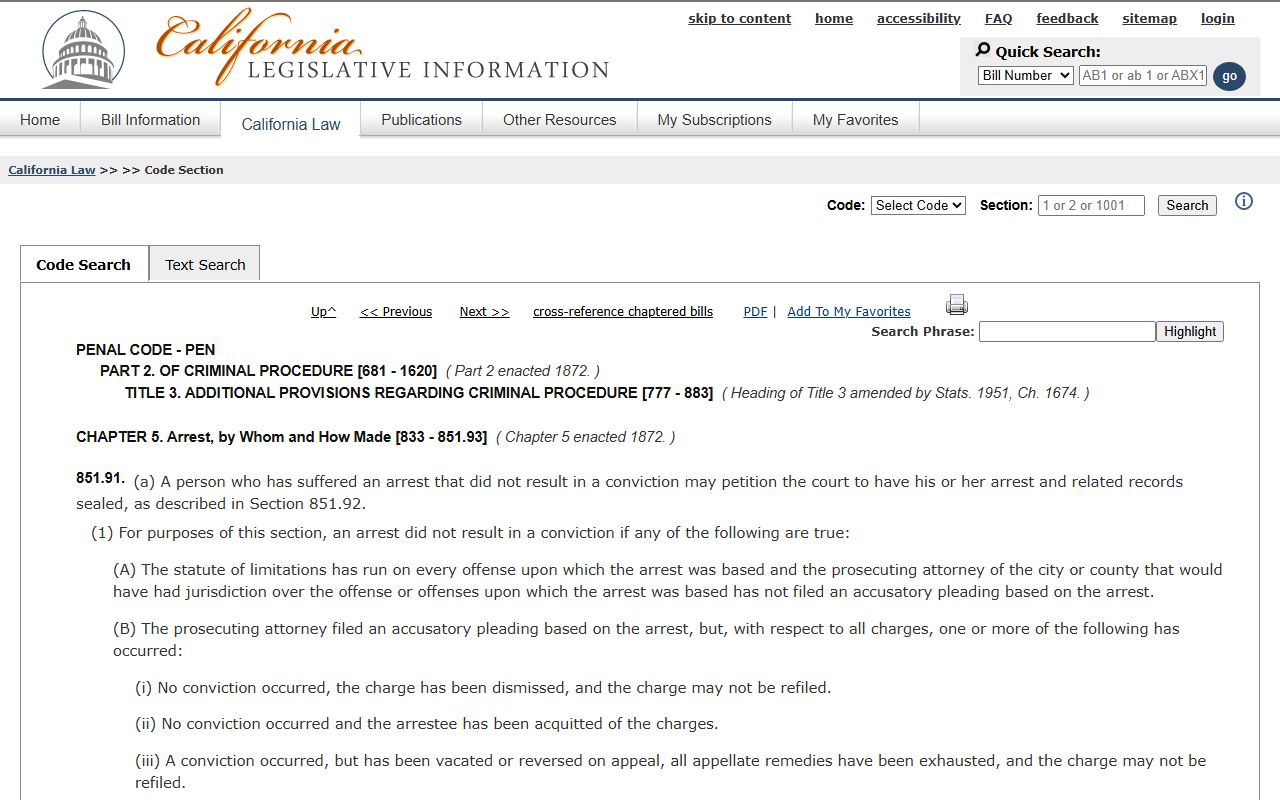
Read the section before filing. The rules on which arrests qualify are strict and tied to the case outcome.
| Sealed Record | Expunged Record | |
|---|---|---|
| Legal Path | Penal Code 851.91 for arrests; WIC 781 for juvenile cases | Penal Code 1203.4 dismissal relief after probation |
| What Happens | Record hidden from public view | Conviction set aside and case dismissed |
| Public Visibility | Not visible to most users | Shows as dismissed, not as a conviction |
| Law Enforcement | Limited access still allowed | Still visible to courts and police |
| Who Qualifies | Arrests with no conviction or eligible juvenile cases | People who finished probation on eligible offenses |
| Effect on Background Check | Should not appear in most reports | May appear with dismissal notation |
Juvenile records sit under their own rules. Welfare and Institutions Code section 781 lets a person seal juvenile court files after set conditions are met. The Placer Superior Court Self-Help Center can point a person to the right forms.
What the Placer Arrest Log Shows
The Sheriff posts a 10 Day Arrest Log as a daily PDF. It is the closest thing to a public arrest blotter for the county. The log covers a rolling ten days, with one line per arrest. The table below lists each field that appears on a sample record from that log.
| Field | What It Shows |
|---|---|
| Report Title | Placer County Sheriff's Office, 10 Day Arrest Log |
| Report Date and Page | Run date of the report and page number |
| Case Number | Sheriff case ID tied to the booking |
| Full Name | Last, first, and middle name of the arrested person |
| Occupation | Self-reported job title at booking |
| Date of Birth | DOB used to confirm identity |
| Eye Color | Booking identifier |
| Hair Color | Booking identifier |
| Sex | Booking identifier |
| Weight | Booking identifier in pounds |
| Height | Booking identifier in feet and inches |
| Completed Date | Date the booking record was finished |
| Arrest Date and Time | When the arrest occurred |
| Arrest Location | City or area within the county |
| Charges | Code section and short description, such as Penal Code 978.5 bench warrant or outside agency warrant |
A few fields you might expect are not in the log. There is no mugshot in the PDF. There is no bond amount. There is no court date. Those facts live in other files. For bond and court date, check the In-Custody Report or call the jail. For mugshots, see the section below.
Mugshots and Booking Photos
Placer County does not publish mugshots in the 10 Day Arrest Log PDF. The In-Custody Report from the Sheriff lists current jail residents and basic booking facts, but mugshot images are not posted in bulk on the public county site. Booking photos may be released on a case-by-case basis under California Public Records Act rules. The Sheriff can withhold images if release would interfere with an active investigation or invade privacy.
A request for a specific mugshot goes to the Sheriff's records unit through the county Public Records Act process. Penal Code section 13125 covers what may be shared from law enforcement files. For a person already charged, the court case file may include identifying photos in evidence, but those are not posted online.
What Is Public and What Is Restricted
Most adult criminal cases in Placer are public, with limits. The case index and docket are open to anyone. Full criminal documents, like motions and probation reports, are courthouse-access only for the public under California Rule of Court 2.503(c). Only the parties, their counsel, and approved users can pull those documents from the eCourt portal. A walk-in at the Gibson Courthouse in Roseville or the Historic Courthouse in Auburn is often the fastest way to see paper or terminal copies.
Some cases are off-limits to the public from the start. Juvenile cases under Welfare and Institutions Code section 827 are sealed by default. Mental health cases are not searchable through a public portal account. Adoption files are confidential under Family Code section 9200. Search warrants and Ramey warrants are not viewable through the public portal. Sealed records cannot be opened unless the court unseals them. Personal data like Social Security numbers, financial accounts, minor names, and victim addresses are redacted.
District Attorney and Public Defender
The District Attorney's office files and prosecutes every criminal case in Placer County. Morgan Gire is the current DA. The office sits at 10810 Justice Center Drive, Suite 240, Roseville, CA 95678. The main line is 916-543-8000. The DA also runs victim services and works with the Sheriff on case review. To check the status of a filed case, the eCourt portal is faster than calling the DA, but the office handles charging questions.
The Public Defender's office defends people who cannot afford counsel. In Placer, that service is run on contract by Koukol & Associates at 3785 Placer Corporate Drive, Suite 550, Rocklin, CA 95765. The phone is 916-644-1100. If the contract firm has a conflict, the court appoints counsel from the county Assigned Counsel Program. A defendant gets a public defender at the first court appearance if they qualify.
The DA and Public Defender both staff Placer's specialty courts. Recovery Court meets in Department 32 on the first, third, and fourth Wednesdays, with a Drug Court calendar in Department 14 on the first Thursday. Mental Health Court runs treatment-based cases for people with a qualifying diagnosis. Veterans Court meets in Department 33 on the second Wednesday. Each program offers alternatives to jail for people who finish treatment and stay on track.
Background Check Considerations
A casual name search is not the same as a Fair Credit Reporting Act background check. The FCRA controls reports used for jobs, rentals, credit, and insurance. An employer who runs a check must use a vendor that follows the FCRA. The vendor must give the applicant notice, get a signed release, and share a copy if the report leads to a bad outcome. A free public records search does not give the same legal protection to either side.
For Placer cases, an FCRA check usually pulls from the court index, the state DOJ, and national databases. It will show the case number, charges, and disposition. It may miss sealed cases. It should not list arrests that did not lead to a conviction if they are older than seven years, under both federal and California rules. State law adds extra limits, such as Labor Code section 432.7, which restricts use of arrest data that did not lead to conviction.
Important. This website is not a consumer reporting agency under the Fair Credit Reporting Act. Information here may not be used for employment, tenant, credit, insurance, or any FCRA-regulated purpose.
DUI and DWI Overlap With Traffic Court
A DUI in Placer County is a criminal case, not a basic traffic ticket. The CHP or local police make the arrest. The DA files charges as a misdemeanor or felony based on prior records and any injury. The case sits on the criminal calendar at the Gibson Courthouse, with a 62 case number. The DMV runs a parallel administrative hearing on the driver's license. For citation lookups and the line between court traffic files and the state driver record, see Placer County traffic court records.