
Common Questions About Placer County Court Records
How do I search Placer County court records online?
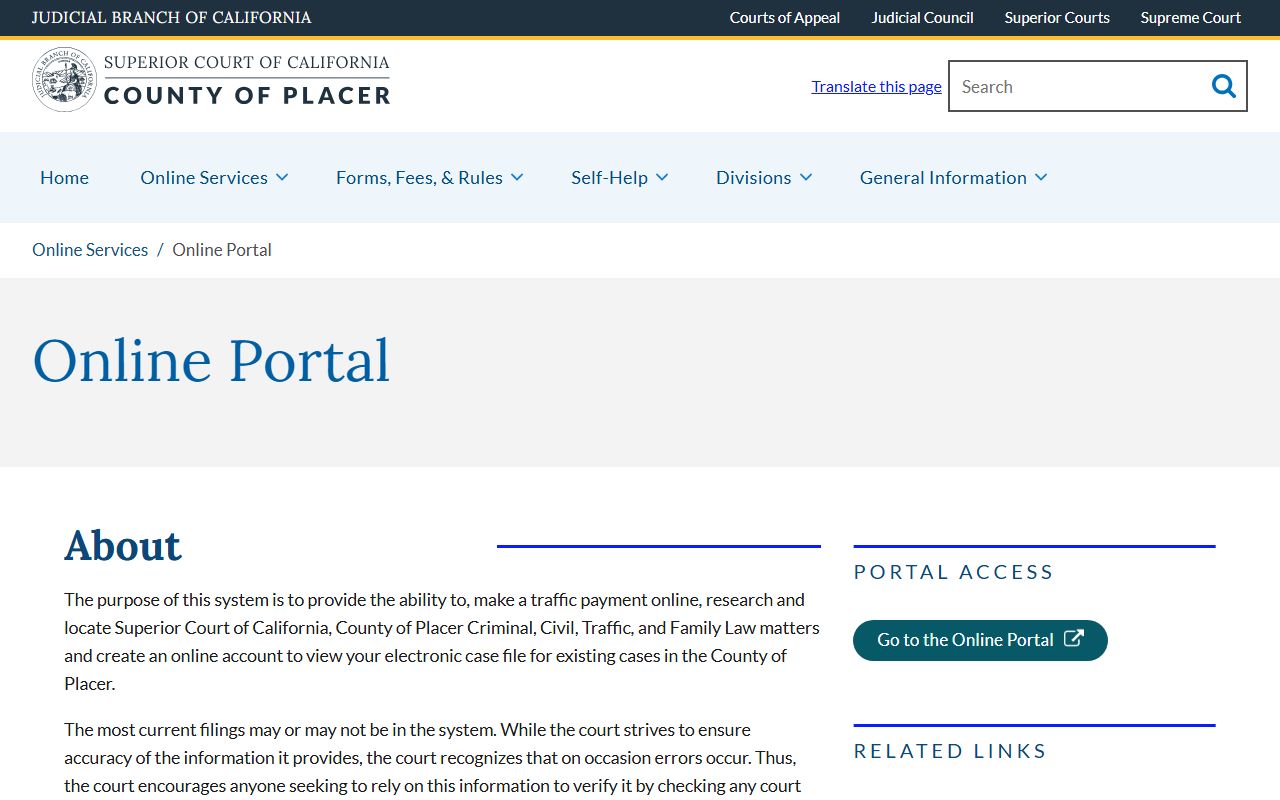
Use the Placer Superior Court Online Portal. Accept the terms, choose "Search for a Case," and search by party name, company name, or case number. The portal requires a filing date or date range tied to the original case filing date. No account is needed for a public case search. For the full walk-through, search fields, and case number formats, see our court records page. The court says some cases will not appear because they are not searchable by design.
Is the online portal the official court record?
No. The portal disclaimer says data from the Online Portal does not make up the official record of Placer Superior Court. It is given "as is." For an official certified record, you must request specific documents from the court in person or in writing under the court's record viewing and copying policy. The full process, fees, and request forms are covered on our court records page. Uncertified prints from the portal are not accepted in legal filings.
Why can't I find my case?
The court's FAQ lists four common fixes. Check the filing date and make sure it is the first filing date, not a later event date. Use the exact case number format with dashes and zeros. Confirm the spelling of the party or company name. If the case still does not appear, contact the court, since some case types are not searchable through the public portal. For more on docket entries and the Register of Actions, see court dockets.
Do I need an account to search case information?
No. No account is needed to search public case information through the Placer portal. An account is required only for eligible parties or attorneys who want to view electronic case files and documents in most case types. Party access requires video identification through Zoom or a courthouse process. Public users can still search basic case details for free. See court records for the full account, identity, and access rules used by the court.
Which case types are searchable?
The portal FAQ says Family, Probate, Civil, Criminal, and Traffic cases are publicly searchable. Document access varies by case type. Adoptions, Mental Health, Juvenile, Search Warrant, Ramey Warrant, and sealed cases are not available for online remote access through portal accounts. Use the courthouse for those. For an overview of how case types map across the divisions of the Superior Court, including which department hears each type, see that page.
Can I view criminal documents online?
Generally no, not as a public remote user. California Rule of Court 2.503 limits public remote access to criminal electronic records. You may see basic case info online, like party names, dates, and charges. Public document access is at the courthouse unless a rule or order allows more. For arrest log details, charges, bail schedules, and the criminal calendar, see criminal records. Certified criminal copies must be requested in person or by mail.
How do I get court copies?
Use the court's Records and Copy Request process. You need a case number. If the clerk has to search by name and it takes more than 10 minutes, a $15 name-search fee may apply. The court does not accept copy requests by phone, email, or fax. Mail requests should include payment and a self-addressed stamped envelope. The Clerk of Court page has the office address, hours, and the full copy and certification process.
Where is the main courthouse?
The Hon. Howard G. Gibson Courthouse is at 10820 Justice Center Drive, Roseville, CA 95678. It houses departments 30 through 44, the Clerk's Office, the Self-Help Center, Jury Services, Family Court Services, the Court Executive Office, and Human Resources. Other departments sit at the Historic Courthouse in Auburn, the Juvenile Courthouse, and the Jail Courtroom. For the full courthouse list, hours, and judicial assignments, see our Superior Court page.
What are courthouse hours?
The Gibson Courthouse and Historic Courthouse clerk offices are open 8:00 a.m. to 4:00 p.m., Monday through Friday, except holidays. The Juvenile Courthouse uses a noon closure: 8:00 a.m. to 12:00 p.m. and 1:00 p.m. to 4:00 p.m. Closures follow the court's published 2026 holiday schedule, which includes Lincoln's Birthday, Farmworkers Day, Juneteenth, and Native American Day. For more service hours and contact info, see the Clerk of Court page.
Where do I find inmate information?
Use the official Placer Sheriff's in-custody report linked from the county View page and the Sheriff's jail pages. The Sheriff's homepage says the in-custody roster shows bail details and booking information. You can also call Auburn Jail at 530-745-8500 or South Placer Jail at 916-409-8100. For the roster fields, booking codes, jail addresses, and visitation rules, see inmate records. The roster updates as bookings and releases process through the jail system.
Where is the arrest log?
The Sheriff's Press Log - Arrests page links the official 10 Day Arrest Log as a PDF. The log shows case number, full name, date of birth, physical description, completed date, arrest date and time, arrest location, and charges. Most public arrest questions can be answered from this PDF before you call the jail. For more on how arrest data feeds into the case system, see criminal records. Older arrests roll off as the log is refreshed every few days.
How do I post bail?
Bail can be posted around the clock at Auburn Jail or South Placer Jail. Accepted methods include exact cash, cashier's or certified check, money order payable as directed, or a licensed bail bond. If you plan to post bail after 7 p.m., call the jail before you arrive. For bail schedules, posting rules, and how a bail amount is set in court, see criminal records. Bail amounts can change at the next court date based on the judge's order.
Does Placer publish a warrant search?
No official active warrant search page was located in inspected court or Sheriff sources. Warrant info may show up in court case files, in the arrest log, in the in-custody report, or through direct contact with the court or Sheriff. Do not rely on third-party warrant sites for legal decisions. Our warrant records page explains what is and is not available, plus how to ask the court or Sheriff about a possible warrant in your name.
Where do I get marriage records?
Marriage records are kept by the Placer County Clerk-Recorder, not the court. The vital records page says marriage records date from 1852 to the present day. Certified copy fees are $19 for a public marriage record and $24 for a confidential marriage record. The Clerk-Recorder also handles marriage license issuance. For the full process, including divorce records held by the court, see our marriage and divorce records page. Mail requests need a notarized sworn statement.
Where do I get divorce records?
Divorce records are family law records held by Placer Superior Court, not the Clerk-Recorder. Basic case info may be searchable in the eCourt portal by filed date and party or case number. Family documents have remote access limits under California Rule of Court 2.503, so most documents are viewed at the courthouse. For copy requests, fee waivers, and the family law forms used in Placer, see our marriage and divorce records page.
Where are probate records?
Probate matters are filed and heard in the Civil Division of Placer Superior Court. Probate case information is searchable through eCourt. Public probate document availability on the portal begins August 28, 2017, the date the court uses for portal document coverage. Guardianship and conservatorship remote access is limited under court rules. For wills, estates, conservatorships, and how to request probate copies, see our probate records page.
What if I cannot afford court fees?
The court's Civil page says a fee waiver may be filed if you cannot afford court fees. The Placer Self-Help Center and California Courts Self-Help offer free forms and guidance for self-represented users. Filing a waiver does not stop your case. For traffic-related fees and the MyCitations online tool, which can lower or set a payment plan for an eligible traffic citation, see our traffic court records page. The waiver applies across most case types.
Are court documents free online?
Basic case searches are free and public. Documents are limited by case type, storage date, court rules, and account access. Civil and probate public document availability through the portal begins August 28, 2017. Older filings and most criminal documents are not online. Copies and certified copies cost fees under the court fee schedule. For what counts as a public record under California law, and where access rules differ, see our public records page.
How do I check if someone was released from jail?
Start with the Sheriff's in-custody report. If a name no longer shows, the person may have been released, transferred, or moved to a state or federal facility. Call Auburn Jail at 530-745-8500 or South Placer Jail at 916-409-8100 to confirm. VINELink can also send free release alerts. For the full release process, including bail, citation release, and OR release, see our released inmates page. Always verify before relying on online data alone.
How crowded are the Placer County jails?
Placer runs two main jails: Auburn Jail and South Placer Jail in Roseville. Daily counts swing based on bookings, releases, court orders, and transfers. The Sheriff publishes operations details, and capacity has been discussed in county budget materials over the years. For background on jail capacity, history of population caps, and what to check in current daily reports, see our inmate population page. Numbers are best verified through current Sheriff data.
How do I find a federal case from Placer County?
Use PACER for official federal dockets. Placer County is in the Eastern District of California for federal district and bankruptcy cases. Federal appeals from Placer cases go to the Ninth Circuit. Federal cases are not in the Placer Superior Court portal, since they belong to a different court system. For background on the county court structure, the divisions, and where each case type is heard, see our Superior Court page. PACER requires a free account.
Still Have Questions?
For the right office, see Clerk of Court. For broader access rules, see public records. For records-by-topic, browse court records, criminal records, inmate records, warrant records, marriage and divorce, or probate.