
How to Search Placer County Traffic Court Records
The main tool is the Placer Superior Court eCourt portal at webportal.placerco.org/ecourtpublic. The portal FAQ names Traffic as one of the five case types open to the public, along with civil, family, probate, and criminal. No account is needed to read a case summary. When a searcher has only a name and a year, the best tool is the Find My Case Number or Citation Number form. The court also serves a Traffic Division page at placer.courts.ca.gov/divisions/traffic that lists the pay, contest, and traffic school paths.
Before you start, get a few items in hand. You need the citation number from the paper ticket, or the last name on the case. A driver license number and a date of birth help with common-name matches. The portal requires a filed year or a date range, so know roughly when the ticket was written. Citation numbers must be typed with the same letters and digits used by the issuing agency.
- Open the eCourt portal at webportal.placerco.org/ecourtpublic and accept the terms.
- Pick "Find My Case Number or Citation Number" or use the main Case Search form for a name and date range.
- Type a last name, an optional first name, or a full citation or case number.
- Set a Filed year or a date range that covers when the citation was filed.
- Open the matching case and read the disposition, the next hearing date, and the balance owed.
- Pay the fine, ask for traffic school, or set the case for court using the links on the case page.
The court hosts a Traffic Division page that walks through the same steps. The lead-in to the portal sits on the Placer Superior Court Traffic Division site. The image below shows that page.
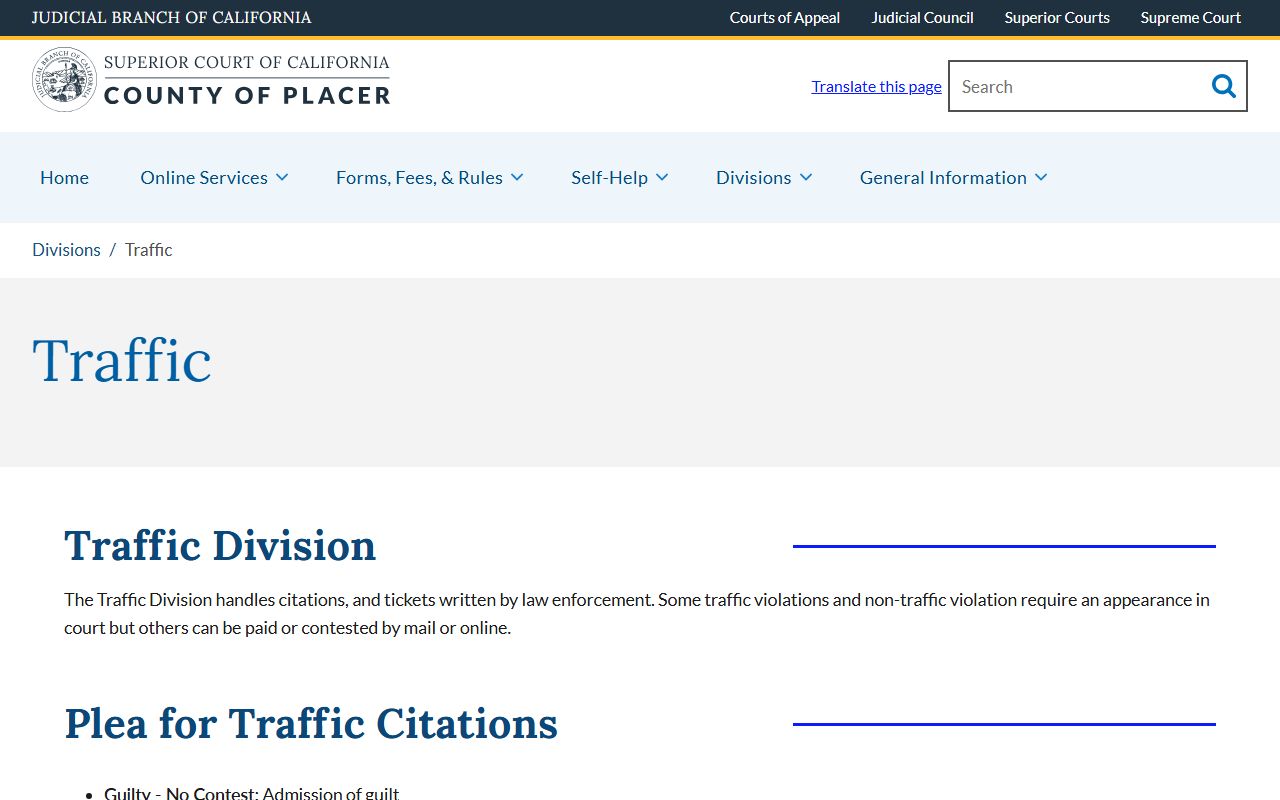
The Traffic Division page is the right starting point for a first-time user. It links to the pay portal, the trial by written declaration form, the traffic school path, and the MyCitations ability-to-pay form.
Which Courts Handle Traffic Cases in Placer County
Under California court unification, there is no separate municipal traffic court or justice court in Placer County. Every ticket written in the county is filed with the Placer Superior Court. Traffic calendars are heard in Department 30 at the Howard G. Gibson Courthouse in Roseville. The court also runs misdemeanor and traffic calendars in Department 14 at the Historic Courthouse in Auburn. Both sites take filings, payments, and walk-in questions from drivers.
The court splits work between the two main sites. Infractions and most pay-or-set matters route to Roseville. Misdemeanor traffic charges, such as driving on a suspended license, are heard at the Auburn courthouse. The traffic mailing address differs from the main court P.O. Box, so mail must go to the right place.
| Court | Traffic Cases Handled | Address |
|---|---|---|
| Gibson Courthouse, Dept. 30 | Traffic and non-traffic infractions, pay-or-set, trial by declaration, officer trial. | 10820 Justice Center Drive, Roseville, CA 95678 |
| Historic Courthouse, Dept. 14 | Misdemeanor and traffic calendars, including suspended-license and reckless driving cases. | 101 Maple Street, Auburn, CA 95603 |
| Traffic Division mailing | Pay-by-mail, trial by declaration packets, traffic school certificates. | P.O. Box 619077, Roseville, CA 95661 |
The phone line for traffic questions is (916) 408-6000. The clerk's office is open Monday through Friday from 8:00 a.m. to 4:00 p.m.
Types of Traffic Cases on Record
Placer Superior Court files several kinds of traffic matters. The bulk of the calendar is moving infractions. The rest is a mix of equipment fixes, parking referrals, commercial driver charges, photo enforcement, and misdemeanor charges that ride alongside a traffic stop. Each type gets its own case file, its own fine table, and its own path to a court date.
- Moving violations - speeding, stop sign, red light, lane change, and other Vehicle Code infractions that carry fines and may add points to the driver record.
- Non-moving and equipment - broken tail light, no insurance, expired tags, and similar fix-it tickets. Many can be cleared with proof of repair.
- Parking - city parking citations referred to court when the driver does not pay the issuing agency.
- Commercial vehicle / CDL - tickets written to drivers with a Class A or Class B license. Masking rules and federal reports apply.
- Photo enforcement - red light camera and speed camera tickets sent through city programs that route to Placer Superior Court.
- Misdemeanor traffic - driving on a suspended license under Vehicle Code § 14601, reckless driving, hit and run with property damage, and other Vehicle Code misdemeanors.
- Failure to appear - Vehicle Code § 40508 charges added when a driver skips a court date or fails to pay.
DUI with injury or repeat priors moves to the Criminal Division as a felony. Vehicular manslaughter and hit and run with injury follow the same path. Those cases show up on the criminal docket, not the traffic docket.
What Placer County Traffic Court Records Show
A Placer traffic case file holds a header with the basic facts and a register of actions that lists every event in date order. The header shows the citation number, the case number, the issuing agency, and the cited Vehicle Code sections. The register shows the plea, hearings, traffic school enrollment, and the final disposition. Some items, such as the driver license number, are masked on the public view.
| Field | What It Shows |
|---|---|
| Citation Number | The number on the paper ticket; ties the citation to CHP, Sheriff, or a city police agency. |
| Court Case Number | Court-assigned number after the citation is filed with Placer Superior Court. |
| Defendant Name | Full name as written on the citation. The DL number is masked from public view. |
| Citation Date and Location | The date and place where the officer wrote the ticket. |
| Issuing Agency | CHP, Placer Sheriff, Roseville PD, Auburn PD, Rocklin PD, Lincoln PD, or another local force. |
| Vehicle Code Section(s) | The cited CVC sections, with one row per charge. |
| Filed Date | The date the citation was filed with the court. Required by the portal search. |
| Hearing / Arraignment | First court date, time, and department. |
| Plea | Guilty, not guilty, no contest, failure to appear, or pending. |
| Disposition | Convicted, dismissed, traffic school completed, bail forfeited. |
| Fine / Bail Amount | Court-set fine and the balance with all penalty assessments added. |
| Traffic School | Whether traffic school was granted, the deadline, and the certificate filing. |
| Trial by Declaration | Whether a written trial under Vehicle Code § 40902 was used and the outcome. |
| Warrant Status | Bench warrant for FTA or FTP and any recall date. |
For a deeper look at how Placer cases are indexed across all case types, see the Placer County court records page or the court dockets page.
Searching by Citation Number vs by Name
Citation number search is the fastest path. Type the citation as it appears on the paper ticket, set the filed year, and click Search. A name search is the right path when the ticket has been lost, but it returns more results. Common names such as Smith or Garcia can return many matches, so adding a first name or an initial helps. The portal does not let a user search by driver license number from the public side.
| Search Field | Type | Required | Notes / Format |
|---|---|---|---|
| Filed | Year dropdown with operator | Yes | Years 2006 through 2025 observed. Operators include equals, not equals, greater than, less than, blank, not blank. |
| Last Name | Text with operator dropdown | Yes | Operators: equals, starts with, ends with, contains, soundex, in, blank, not blank. Soundex helps with misspelled names. |
| First Name | Text with operator dropdown | Optional | Same operator list. Use a first initial when the full first name is unknown. |
If a search fails, three checks help. Make sure the Filed year matches the year the citation was filed, not the year the ticket was paid. Check the last name spelling and try soundex. If the case is still missing, call the Traffic Division at (916) 408-6000. Citations older than the retention period under Government Code § 68152 may no longer appear on the portal.
Paying or Contesting a Placer County Traffic Ticket
The online pay portal is at placer.epay-it.com. The portal does not require an account. A driver can pay by Visa, Mastercard, Discover, or American Express. Pay-by-mail uses a check or money order to the Traffic Division at P.O. Box 619077, Roseville, CA 95661. In-person pay is taken at the Gibson Courthouse clerk window in Roseville and the Historic Courthouse window in Auburn during clerk hours. Posted deadlines on the citation must be met to avoid a Vehicle Code § 40508 charge and a hold on the DMV record.
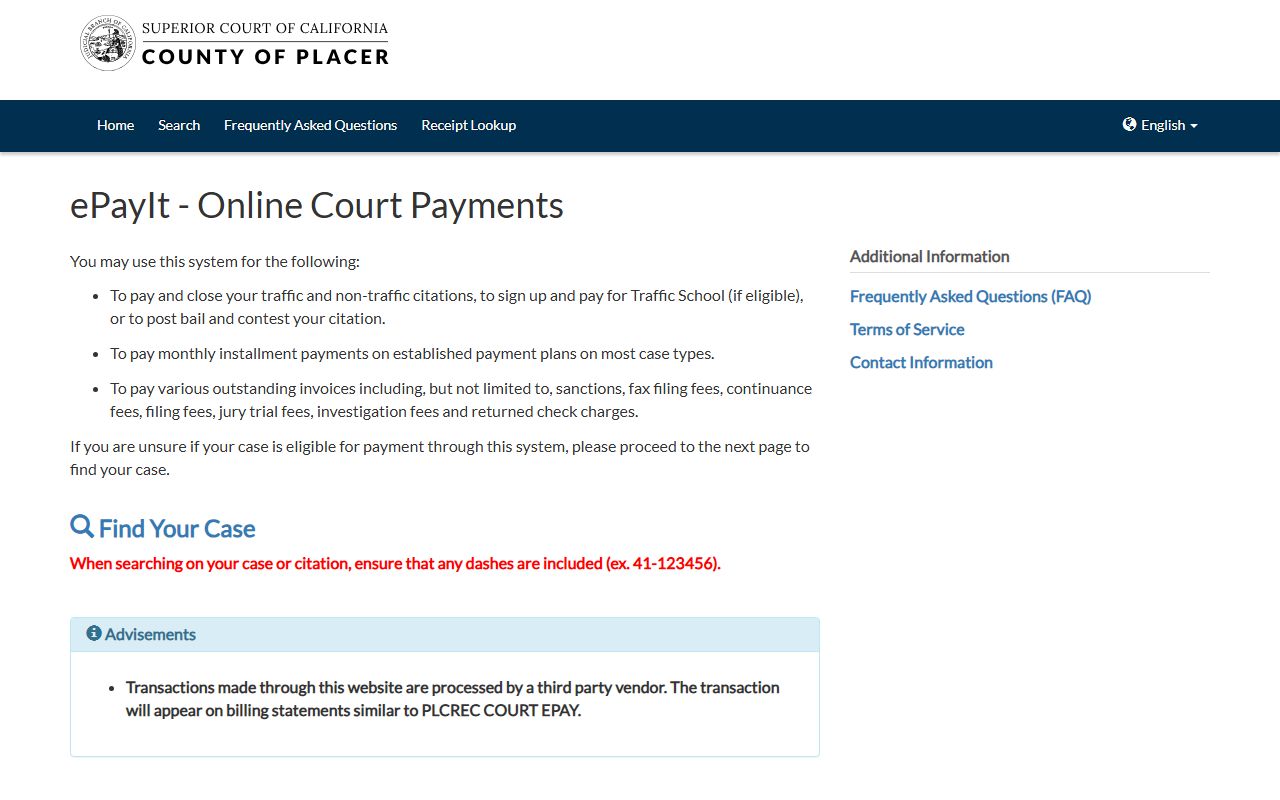
The payment portal screen confirms the citation, the balance, and the assessed fees before the card is charged. A driver can also ask for an ability-to-pay reduction through California's MyCitations program at mycitations.courts.ca.gov. Income-eligible drivers may get a reduced fine, a payment plan, or community service in lieu of fine.
- Read the paper ticket. Note the citation number, the cited Vehicle Code section, the due date, and the issuing court.
- Look up the case on the eCourt portal to confirm the bail amount and the next court date.
- Pick a path: pay in full, ask for traffic school, set the case for an officer trial, or file a trial by written declaration under Vehicle Code § 40902.
- To pay, use placer.epay-it.com, the mail-in slip, or the clerk window. To request a reduction, file MyCitations.
- For a written trial, send the form and the bail to the Traffic Division. If found not guilty, the bail is refunded; if found guilty, the conviction posts to the DMV record.
- For an officer trial, ask the clerk to set the case. Show up on the date listed and bring all witnesses and proof.
- Confirm the disposition on the portal a few days after the hearing. Check that the DMV record matches.
Plea options include guilty, not guilty, and no contest. A no-contest plea acts as guilty for sentencing but blocks use of the plea in some civil claims. Remote Zoom appearances are offered for some traffic calendars; the clerk can confirm whether a given case may go forward by video.
Public Access Laws for Traffic Court Records
Two tracks govern access in California. The California Public Records Act, recodified at Government Code § 7920.000 and following, covers most county agency records. Court case files, including traffic cases, sit under the California Rules of Court and case-type confidentiality rules. Placer Superior Court's policy states that all documents in a court file are public unless made confidential by statute, rule, court order, or case law. Remote portal access is always narrower than what the public can see at the clerk's window.
The court's eCourt portal lists Traffic as one of the case types open to the public. Sealed traffic cases and juvenile traffic referrals do not appear remotely. Officer trial filings, trial by written declaration packets, and traffic school certificates are part of the public file at the courthouse.
Key Statutes:
Government Code § 7920.000 - sets the California Public Records Act framework for agency records.
California Rule of Court 2.503 - sets the remote electronic access limits the Placer portal relies on.
Vehicle Code § 40902 - allows a contested infraction to be tried by written declaration.
Vehicle Code § 40508 - creates the failure-to-appear and failure-to-pay charge.
Government Code § 68152 - sets minimum court-record retention periods for infraction files.
Note: Online case data is not the official record; key facts should be checked against the certified file held by the Clerk of the Superior Court.
Court Traffic Records vs State Driver Records
The Placer Superior Court traffic record and the California DMV driver record are two different files. The court record is the case file held by the clerk. The driver record is the H6 abstract held by California DMV. A driver who clears a ticket in Placer should check both files. Court dismissals do not always update the DMV abstract right away. Errors in the court file are fixed at the court; errors on the DMV record are fixed at the DMV.
| Compare | Court Traffic Record | State Driver Record |
|---|---|---|
| Record source | Clerk of the Placer Superior Court Traffic Division. | California Department of Motor Vehicles. |
| What it contains | Citation, plea, hearings, orders, fines, traffic school filings, and disposition for the one case. | Convictions, accidents, license actions, suspensions, points, FTAs, and SR-22 filings statewide. |
| Where to access | eCourt portal at webportal.placerco.org/ecourtpublic, clerk window, or mail request. | California DMV request page at dmv.ca.gov. |
| How to correct errors | File a motion or written request with the Traffic Division, or talk to the clerk at the courthouse. | File a DMV driver record correction request and send proof from the court. |
Traffic school is the clearest example of how the two files split. A traffic school disposition stays in the court file. On the DMV record, traffic school masks the conviction so points do not post and insurance does not see the hit. The court does not erase the citation, but the DMV does not show the conviction.
CDL and Commercial Driver Records
Commercial drivers face a stricter set of rules. California Vehicle Code § 15300 and federal 49 CFR Part 384 prohibit masking traffic convictions for CDL holders, even when the citation was written in a personal car. A CDL driver generally cannot use California traffic school to clear a conviction off the driving record. Out-of-state tickets are reported back to the home state under the Driver License Compact. A first-offense DUI, a refusal, leaving the scene, using a vehicle to commit a felony, driving while disqualified, and the federally defined serious traffic violations all carry CDL-specific penalties.
Placer Superior Court still hears the citation in the same way it hears any other traffic case. The catch is that the plea has heavier outside effects for a CDL holder. A CDL driver should talk to counsel before pleading, even on a simple speed ticket, because the federal report can lead to a disqualification.
DUI / DWI Cases
California uses the term DUI. First and second DUI without injury are misdemeanors filed under the criminal case number system. DUI with injury or with priors may be charged as a felony. Misdemeanor DUI calendars are heard in Department 33 on an odd/even rotation. Felony DUI calendars also run in Department 33. The traffic stop and the citation appear in traffic records, but the case itself moves to the Criminal Division.
DUI cases also trigger an administrative per se hearing by California DMV. The driver must request that hearing within 10 days of arrest. The DMV action runs on its own track and is separate from the criminal court case. For full Placer County DUI case details, plea paths, sentencing, ignition interlock rules, and license consequences, see Placer County criminal records.
Deferred Adjudication and Defensive Driving Course
California does not use Texas-style deferred adjudication for traffic infractions. The closest fit is traffic school. A driver may ask for traffic school on one eligible offense per 18 months under California Rules of Court 4.104 and Vehicle Code §§ 41501-41502. The court charges a traffic school fee on top of the bail, and the driver must finish a state-licensed course and file the certificate by the court's deadline. Eligibility is set by the type of violation; most one-point moving infractions in a non-commercial vehicle qualify.
Traffic school does not erase the citation from the Placer Superior Court file. The court record still shows the citation, the traffic school grant, and the certificate filing. What traffic school does is mask the conviction on the DMV abstract for point and insurance purposes. For misdemeanor or felony traffic convictions, the dismissal relief path is Penal Code § 1203.4, filed after probation is finished and all fines are paid.
Sealing or Expunging Traffic Records
Infraction citations stay part of the public court record. Once the fine is paid and the case is closed, the file sits in the court system until the retention clock runs out under Government Code § 68152. There is no full erasure path for an infraction in California. Sealed traffic cases do not appear on the eCourt portal for remote view.
Misdemeanor and felony traffic convictions follow the broader California relief framework. Penal Code § 1203.4 dismissal relief can apply after probation is finished, for charges such as VC § 14601 driving on a suspended license, reckless driving, or a first DUI. Penal Code § 851.91 allows sealing of arrest records when the arrest did not lead to a conviction. The Clean Slate provisions at Penal Code § 1203.425 give automatic relief in some cases. None of these paths destroy the court file outright; they change how the case may be reported and used.
Fees for Traffic Record Copies
Plain copy fees follow the statewide civil fee schedule. Certified and authenticated copies follow Government Code § 70626 and § 70629. A name search by the clerk that runs more than 10 minutes triggers a search fee. Self-help name lookups at the public terminal are free during clerk-office hours. The traffic ticket fine itself is set by the Uniform Bail and Penalty Schedule and is separate from copy fees.
| Item | Amount |
|---|---|
| Plain copy per page | $0.50 |
| Certified copy (no other fee fixed) | $40.00 |
| Authentication per signature | $15.00 |
| Name search fee (per name, if over 10 minutes) | $15.00 |
| Public terminal name lookup | Free |
| California DMV driver record | Set by DMV; see dmv.ca.gov |
Phone, email, and fax copy requests are not accepted. Mail requests use form PL-CW001 with a self-addressed envelope and a check to Placer Superior Court. For more on clerk fees and forms, see the Clerk of the Superior Court page.