
What Placer County Probate Covers
The probate division handles four main case types. Decedents' estates make up the largest group. A judge will read the will, name an executor or personal representative, and supervise the payout of debts and gifts. Trust matters cover the legal entities that hold property for another person. Heirs, creditors, and trustees may all be parties. The court can rule on accountings, claims, and final distribution.
Guardianship cases involve minors. A parent, relative, or other adult asks the court to name a guardian who can act for a child. The probate guardianship process does not apply when the juvenile dependency court has placed a minor with a non-parent. Conservatorship cases involve adults who cannot meet their own needs or manage their funds. The court can name a person or agency to make those choices for them. Both case types are watched closely. Reports, accountings, and hearings continue for as long as the order is in force.
Every probate case is filed at the civil division. The court's probate division page spells out the four case types and links to the state self-help site for forms and steps.
Placer County Probate Terms
Probate uses a small group of legal words that come up in nearly every case. The list below covers the most common ones. The clerk's intake staff and the Self-Help Center use the same terms when they walk a filer through a case.
- Testator
- The person who made the will. After death, the will speaks for the testator.
- Executor
- The person named in the will to carry out its terms. Also called the personal representative once the court signs the order.
- Intestate
- Dying without a valid will. State law then sets who inherits.
- Guardianship
- A court order placing an adult in charge of a minor child's care, funds, or both.
- Conservatorship
- A court order placing a person or agency in charge of an adult who cannot meet personal or money needs.
- Letters Testamentary
- The court paper that proves the executor has the legal power to act for the estate. Banks and title firms ask to see them.
How to Search Placer County Probate Cases
Probate is one of the case types open to the public on the Placer Superior Court eCourt portal at https://webportal.placerco.org/ecourtpublic/. No login is needed for a basic case search. Public probate documents began going online on August 28, 2017. Older cases may show on the docket, but the file itself must be viewed at the clerk's counter.
- Open the eCourt public portal and accept the terms. Choose "Search for a Case" under Public Services.
- Use Case Search-EXT. Enter a party name, company name, or case number. A filing date or date range is required, so pick a wide window if you are not sure.
- Click Search. Open the case summary and the register of actions to view docket entries. Public documents from after August 28, 2017 may be viewable; sealed and confidential filings will not show.
An overview of the probate division gives the most current scope of cases the court hears. A live look at the probate division page is the best starting point before you file or search.
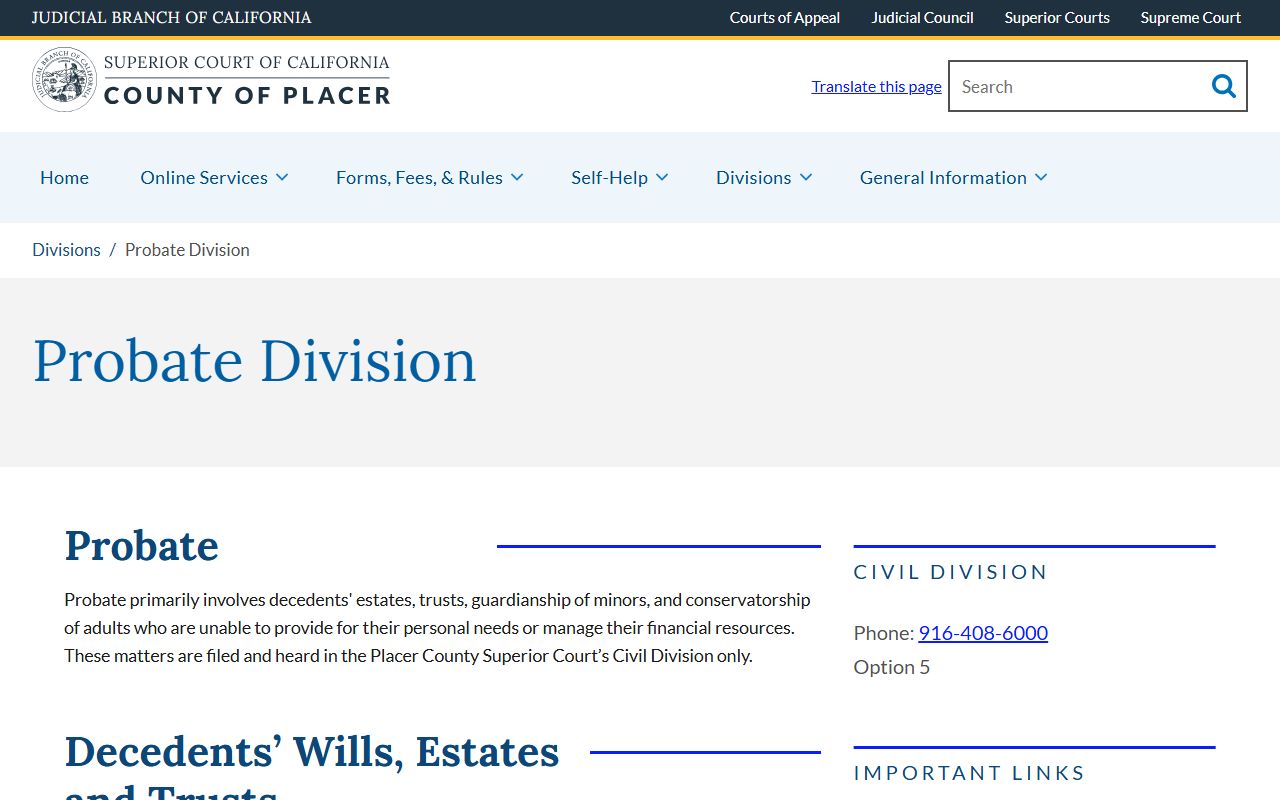
The screenshot shows the four core case types and the links the court hands to self-represented filers. Most users start here, then move to the portal to search or to the clerk's office to file.
Placer County Probate Court Contact
Probate is not a stand-alone court. It is a part of the civil division of the Superior Court. All filings, hearings, and copy requests go through that division. The court's main number rings to the clerk's office at the Gibson Courthouse.
Probate Division, Placer Superior Court
Hon. Howard G. Gibson Courthouse
10820 Justice Center Drive
Roseville, CA 95678
(916) 408-6000
Monday-Friday, 8:00 a.m. to 4:00 p.m.
Mail: P.O. Box 619072, Roseville, CA 95661-9072
Note: Phone, email, and fax copy requests are not accepted; copy orders must be made in person or by mail.
Placer County Probate Filing Fees
Probate filing fees are set by the Statewide Civil Fee Schedule. The court also charges fees for plain copies, certified copies, and authentication. A fee waiver may be granted to filers who qualify under state rules. Confirm the exact fee on the most current schedule before you mail or hand-file.
| Item | Amount |
|---|---|
| Plain copy of a court record | $0.50 per page |
| Certification of a copy (GC 70626(a)(8)) | $40 |
| Authentication per signature (GC 70629) | $15 |
| Name search if clerk time exceeds 10 minutes | $15 per name |
| Probate petition first paper | Per Statewide Civil Fee Schedule |
Pay by check or money order made out to Placer Superior Court. Mail orders should include a self-addressed return envelope with enough postage. Large copy orders may be picked up later, with payment due at the time the order is placed.
What Placer County Probate Records Show
A probate file builds up over the life of the case. Early on, the court holds the will, the petition for probate, and the notice to heirs. Once Letters issue, the executor files an inventory and appraisal of estate assets. As claims come in, the file grows with creditor claims, court orders, and accountings. The final filing is the petition for distribution or trust closure.
Expected fields on a public probate case record include the case number, case title, filing date, case category, petitioner, decedent or conservatee or minor name, attorney of record, hearing dates, register of actions, and a document list for filings on or after August 28, 2017. Orders, Letters, inventories, and accountings show up on the docket. Confidential reports may be marked as restricted.
Will lodging is its own step. Probate Code § 8200 tells the custodian of a will to deliver it to the clerk of the court after the death of the testator. Lodging a will does not start the probate case. It just puts the will on file until someone petitions to open the estate.
Small Estate Affidavit Option
Not every estate goes through full probate. State law sets a dollar limit for the small estate affidavit process. Heirs can collect personal property with a sworn affidavit when the estate falls under the cap.
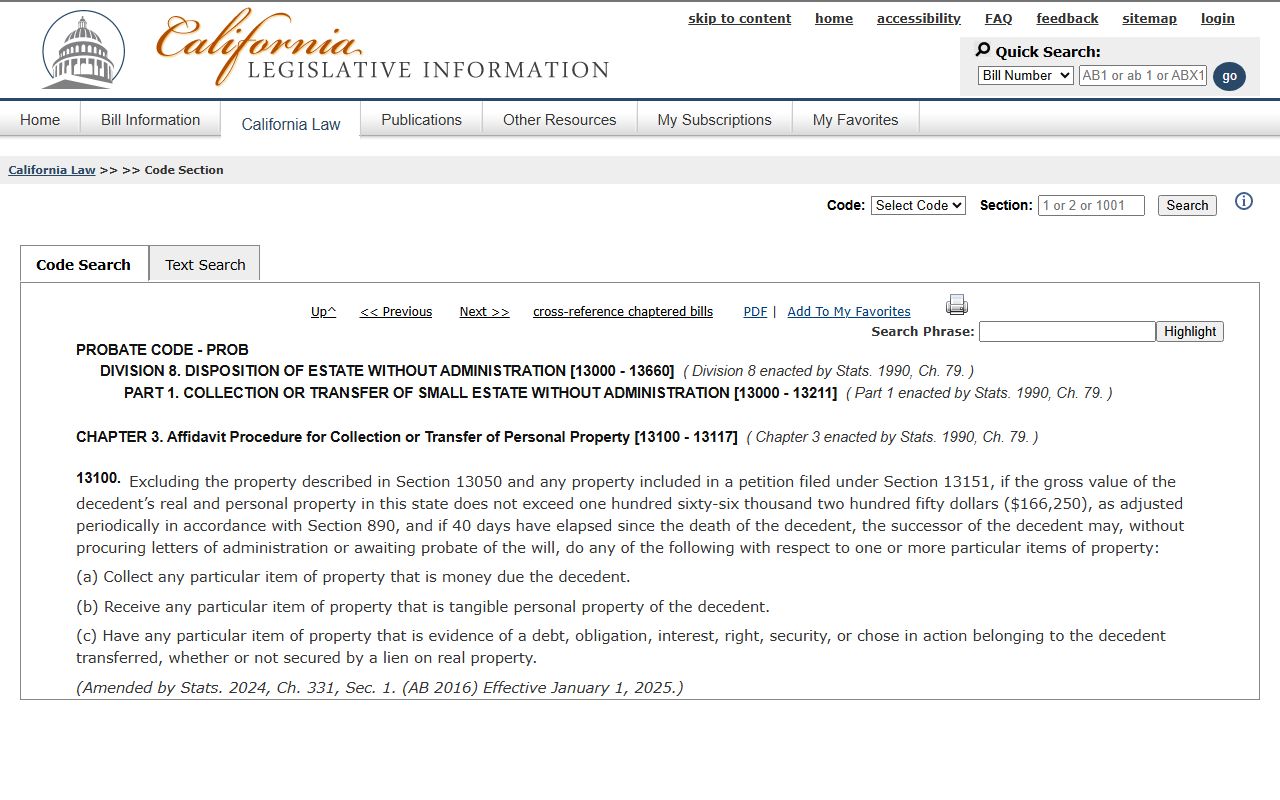
The full text is on the state legislature page for Probate Code § 13100. This is the most cited statute for small estate transfers in Placer County. The affidavit lets a successor of the decedent claim cash, stocks, or other personal property without a court case, as long as the value cap and waiting period are met.
Restricted Placer County Probate Records
Some probate files are not open for remote public viewing. Guardianship and conservatorship cases are the main group. Under California Rule of Court 2.503(c), electronic public access to those cases is limited to courthouse computers. A user must come in to view the documents, and even then medical reports, court investigator reports, and other confidential filings may be sealed.
Sealed records, minor name redactions, and confidential settlements are also off limits. The portal will list that a case exists but will not show the documents. Decedent estates and trusts are more open. Most filings in those cases can be searched and viewed once they post to the docket.
Placer County Self-Help and Forms
The court runs a Self-Help Center that gives free help to people without a lawyer. Staff can walk you through probate forms, talk you through filing steps, and point you to state-wide guides. Help is offered by phone, video, walk-in, live chat, and pre-set appointments.
The center cannot give legal advice or pick a strategy for a case, but it can fill the gap for filers who do not have counsel. The California Courts Self-Help site at https://selfhelp.courts.ca.gov/ holds the master set of probate forms and step-by-step guides linked from the Placer probate division page.