
Active Warrants in Placer County
Placer County does not publish an official public active warrant search. Research of the Placer County Sheriff's Office site and the Placer Superior Court site turned up no named-search warrant database. The Sheriff lists a 10 Day Arrest Log and an In-Custody Report on the county "View" page, but neither one is a warrant lookup. Both are post-arrest reports. A person can appear on those reports because of a bench warrant or outside agency warrant, but the public cannot pull a clean list of every open warrant by name. This is a real gap. Some California counties run named warrant search tools. Placer does not.
Warrants still exist in the county. They live in three places. First, the issuing judge's case file at the Superior Court. Second, the Sheriff's records system and the state-level Wanted Persons System. Third, the booking record at the Auburn Jail or South Placer Jail once an arrest is made. The only way the public sees a warrant before arrest is through the criminal case docket on the court's eCourt portal. The court portal FAQ states that Search Warrant and Ramey Warrant cases are unavailable for online remote access through a portal account, so even the court portal is limited.
To confirm whether a warrant exists, the practical path is to call the Superior Court at (916) 408-6000 or the Sheriff's Office at 530-889-7800. An attorney can also pull the docket and check for a recall date. The county Sheriff's homepage notes the in-custody jail roster provides bail details and booking information for current inmates, which is the closest the public gets to a real-time warrant tool. For an out-of-county warrant, the answer can live in another county's system, not Placer's.
Types of Placer County Warrants
Five warrant types show up most often in Placer County cases. Each one comes from a different rule and serves a different purpose. The label on the warrant controls who can serve it, how bail works, and whether the file is sealed. Penal Code § 813 covers arrest warrants on a complaint. Penal Code § 1523 defines a search warrant as a written order in the name of the people, signed by a magistrate and directed to a peace officer. The links below go to the official state code.
| Warrant Type | Who Issues It | Typical Trigger | Public Access |
|---|---|---|---|
| Arrest warrant | Magistrate or judge | Probable cause shown in a sworn complaint under Penal Code § 813 | Often listed on the criminal case docket once the case is filed |
| Bench warrant | Superior Court judge | Failure to appear, probation violation, contempt | Shows on the case docket; may be recalled by motion |
| Search warrant | Magistrate under Penal Code § 1523 | Sworn affidavit showing probable cause for a search | Not available on the remote portal; copy request only by form |
| Ramey warrant | Magistrate before a complaint is filed | Police affidavit when the case has not yet been charged | Not available on the remote portal per court FAQ |
| Outside agency warrant | A court in another county or state | Warrant from elsewhere; Placer holds the person | Listed in the Placer arrest log as "O/W" felony or misdemeanor |
An arrest warrant lets a peace officer take a person into custody anywhere in the state. A bench warrant comes straight from the bench during a hearing, almost always after a no-show. A search warrant points at a place or item, not a person, and must be returned to the magistrate under Penal Code § 1534. A Ramey warrant is California-specific and is used when officers want to make an arrest before the District Attorney files charges. An outside agency warrant is the catch-all label Placer uses for warrants issued by another agency.
How to Confirm a Placer County Warrant
The first step is to figure out which court or agency issued the warrant. Most active warrants in Placer County trace back to the Superior Court. A small share come from federal court or from another California county. Confirming a warrant before turning yourself in matters because it sets bail, charge level, and the court date. Calling the wrong office wastes time. Calling the right one can resolve a case in a single morning.
- Pull the case on the Placer Superior Court eCourt public portal. Use the last name and first name, or the case number if it is known. Bench warrants tied to a missed hearing show on the case docket.
- Call the Superior Court at (916) 408-6000 and ask the criminal or traffic clerk to check the case status. The court does not give legal advice, but the clerk can confirm whether a warrant is open.
- Call the Sheriff's Office at 530-889-7800 for warrants tied to a sheriff investigation. For custody questions, call Auburn Jail at 530-745-8500 or South Placer Jail at 916-409-8100.
- Hire a defense attorney to run a full check. An attorney can spot Ramey warrants and sealed warrants that the public portal does not show.
- Avoid third-party warrant sites. Many are out of date. None are official.
If the warrant is from another county, ask which agency is holding it. The Placer arrest log labels these as "O/W" outside agency warrants. The receiving agency, not Placer, sets the resolution path.
What a Placer Warrant Record Shows
Because Placer County does not publish a stand-alone warrant page, the public-facing warrant information appears inside the Sheriff's 10 Day Arrest Log and the In-Custody Report. The arrest log is a daily PDF. It lists every adult booking from the prior ten days. Each entry has the same field set. The list below is the actual field inventory from a sample 10 Day Arrest Log applied to warrant entries.
| Field | What It Shows |
|---|---|
| Case Number | Sheriff case number tied to the booking and the warrant. |
| Full Name | Last name, first name, and middle name as booked. |
| Date of Birth | Adult booking only; juvenile bookings are not in the public log. |
| Eye Color | Physical descriptor used to confirm identity. |
| Hair Color | Physical descriptor used to confirm identity. |
| Sex | Field as recorded at booking. |
| Weight | Weight as recorded at booking. |
| Height | Height as recorded at booking. |
| Completed Date | Date the booking entry was finalized. |
| Arrest Date and Time | When the arrest occurred. Sets the start of the custody clock. |
| Arrest Location | City, street, or facility where the arrest happened. |
| Charge(s) | Penal Code citation plus label such as bench warrant failure to appear misdemeanor, or outside agency warrant felony. |
Two fields most people expect are not in the arrest log. There is no warrant number printed. There is no issuing court or bail amount in the sample pages. To get those details, the next stop is the case docket or a direct call to the clerk. Mugshots do not appear in the arrest-log PDF either. The In-Custody Report adds bail details, booking information, and visiting times for people who are still being held, per the Sheriff's homepage.
How to Resolve a Placer County Warrant
Resolving a warrant in Placer County is a process. There is no online portal that closes a warrant by clicking a button. The path depends on the type of warrant, the bail status, and whether the case is a misdemeanor or a felony. Felony warrants and no-bail warrants almost always require a court appearance. Misdemeanor bench warrants for failure to appear can often be cleared by walking into the clerk's office or by having an attorney calendar the matter for recall.
- Confirm the warrant exists. Use the Superior Court at (916) 408-6000, the Sheriff at 530-889-7800, or pull the eCourt docket. Do not skip this step.
- Talk to a defense attorney before any in-person surrender. The Placer County Public Defender serves people who cannot afford private counsel.
- If the warrant is bailable, find the bail amount on the court order or call the jail. Bail can be paid in cash for the exact amount, or by cashier's check, certified check, or money order payable to the Placer Trial Court. A licensed bail agent can also post a bond.
- Post bail at the jail. Auburn Jail and South Placer Jail both accept bail 24 hours a day, 7 days a week. If posting after 7 p.m., call the jail first so a deputy is ready to process the paperwork.
- If the warrant is for a missed court date, ask the attorney to file a motion to recall and quash the warrant. The court can put the case back on calendar without an arrest.
- For a no-bail warrant or a probation violation, expect to remain in custody until a hearing. The court sets release terms at that hearing.
- For an out-of-county or out-of-state warrant, the case is governed by the issuing court. Placer will hold the person until transfer or release is sorted.
Important: Talk to a lawyer before turning yourself in on any felony warrant or no-bail warrant. An attorney can often set up a planned surrender that protects bail eligibility.
Requesting a Copy of a Placer Search Warrant
Search warrants are handled by the Superior Court but are not browsable on the public portal. The court FAQ states that Search Warrant and Ramey Warrant cases are unavailable for online remote access through a portal account. To get a copy of an executed search warrant, the requester files form PL-CW012 Request for Copy of Search Warrant. The form is dated effective July 21, 2021. It asks for the case caption, the Superior Court of California, County of Placer label, and the law enforcement agency that executed the warrant.
An image of the official state code page for Penal Code § 851.8, which governs factual innocence findings tied to arrest and warrant records, is shown below. The page is hosted on the official California Legislative Information site, leginfo.legislature.ca.gov. This is the same source used for the search warrant statute and is the only authoritative source for the current text of the code.
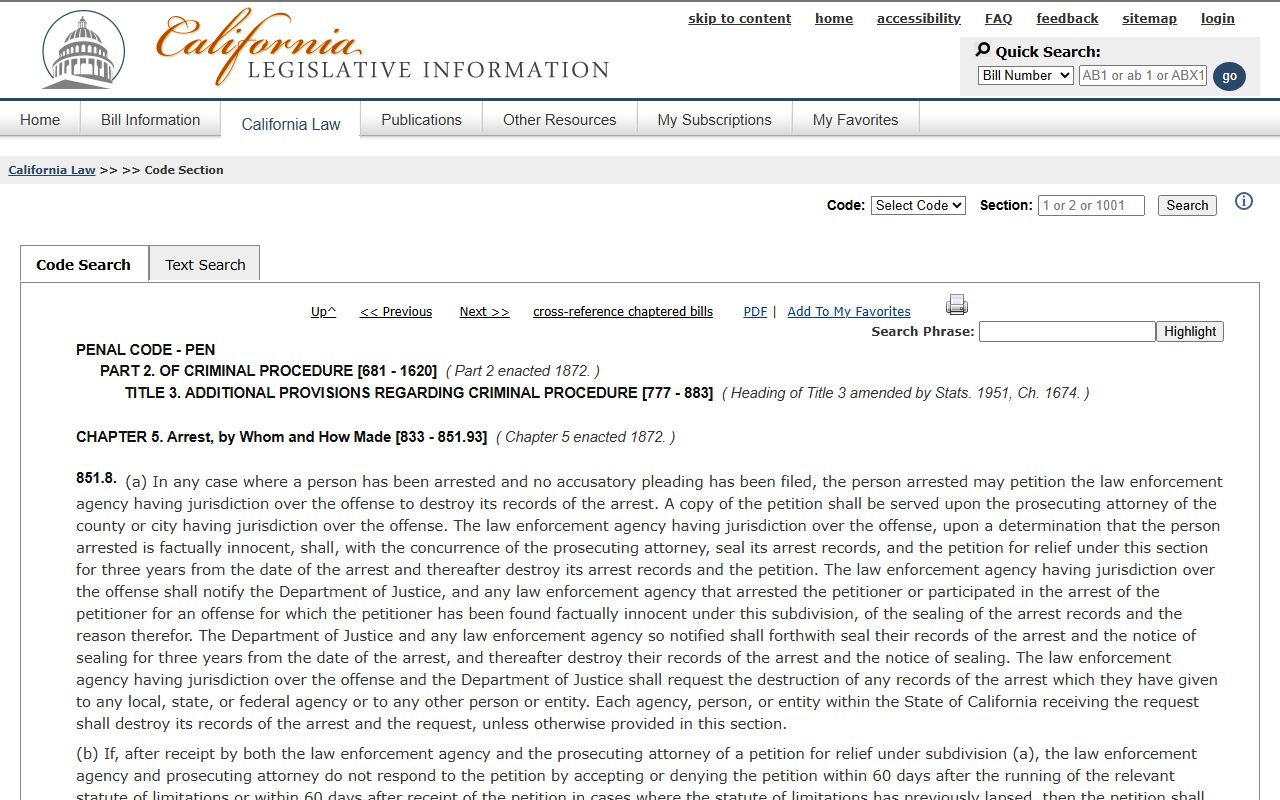
The factual innocence statute matters for people whose Placer warrant or arrest did not lead to conviction. A finding of factual innocence can support sealing under Penal Code § 851.8 and is separate from the dismissal relief in Penal Code § 1203.4. For routine search warrant copies, the PL-CW012 form is the right path. For a sealed search warrant affidavit, expect a delay or a denial until the underlying investigation closes.
Sealed and Restricted Placer Warrants
Not every warrant is public. Several categories are sealed or restricted by law. Search warrant affidavits are often sealed during an active investigation to protect informants and pending leads. Ramey warrants tend to be sealed because the case has not yet been charged. Juvenile warrants are confidential under Welfare and Institutions Code § 827. Warrants tied to grand jury matters can be sealed under separate court order. Federal warrants do not appear in Placer's system at all; those run through the U.S. District Court for the Eastern District of California in Sacramento.
The California Public Records Act, in Government Code § 7923.600, allows law enforcement to withhold investigatory files. That exemption covers warrant affidavits and supporting reports while a case is active. Once the case closes, more of the file may open up. The public can still see that a sealed order exists; the content stays under seal until the court unseals it.