
California Public Records Act in Placer County
The California Public Records Act, known as the CPRA, governs access to records held by county and local agencies in Placer County. The law was first enacted in 1968. It was recodified into Government Code Division 10 in 2023, starting at Government Code section 7920.000. The move did not change the substance of the act. The rule is simple. Public records are open. Exemptions are narrow. Agencies must point to a statute when they say no.
Under Government Code section 7922.000, public records stay open unless an exemption applies. The section also holds the public-interest balancing test. An agency may withhold a record only when the public interest in not disclosing it clearly outweighs the public interest in disclosure. That test gets used for active probes and for files that hold deep privacy concerns. Placer agencies cannot use a vague claim of "internal use" to block a request.
Court case records sit in a different lane. Court files are governed by California Rules of Court 2.400, 2.503, and 2.550, plus case-type statutes. For court case files, see the court records page. For agency records, the CPRA is the right tool.
Key CPRA Statutes for Placer County Requests
- Government Code § 7920.000 - CPRA title and recodification, effective 2023, no substantive change from the 1968 act.
- Government Code § 7922.000 - Public-access framework and the public-interest balancing test.
- Government Code § 7922.600 - Duty to assist. Agencies must help requesters frame focused requests for records that can be found.
- Government Code § 7923.600 - Law enforcement investigatory file exemption. Active probe materials, raw incident files, and warrant affidavits often fall here.
The California Legislative Information site posts every section in full text. A first look at section 7920.000 sets the frame for any Placer County request. The screenshot below shows the official page.
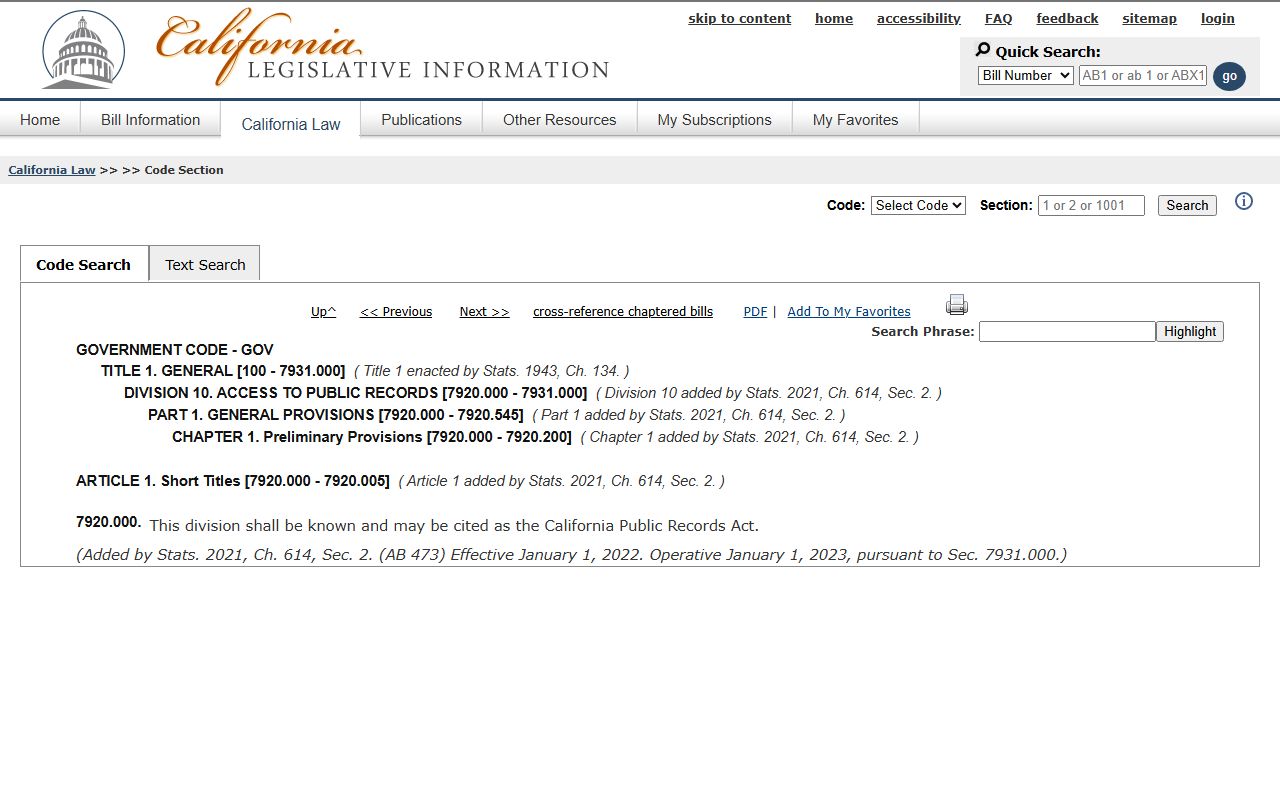
Use the statute text when a Placer agency drags its feet or denies a request without a section cite. The CPRA lets a requester push back with the right code reference.
Records the Placer County Clerk-Recorder Holds
The Clerk-Recorder is the main keeper of non-court county records in Placer. Ryan Ronco serves as County Clerk-Recorder-Registrar of Voters. The main office is at 3715 Atherton Road, Rocklin, CA 95765. The phone line is 530-886-5600. A satellite office sits at 2954 Richardson Drive in Auburn. The Recorder's side files documents that give constructive notice of real-estate deals. The Clerk's side handles vital records, marriage licenses, and business filings. The county site links to a real-property search portal called CountyFusion for deeds and recorded documents.
The official Clerk-Recorder real property portal at CountyFusion is the search front-end for recorded land documents.
That portal handles deeds, deeds of trust, liens, and other recorded land documents going back through the office's recording history. The list below covers the main record types under the Clerk-Recorder.
- Recorded deeds, deeds of trust, liens, and other real-property documents back through the recorder archive.
- Birth and death records from 1873 to present; marriage records from 1852 to present.
- Public and confidential marriage licenses, plus civil ceremony services in English.
- Fictitious Business Name (FBN) statements for businesses doing trade in Placer County.
- Notary bonds, professional registrations, and similar filings required by state law.
- Passport processing by appointment, Monday through Friday, 8 a.m. to 3 p.m.
For court case files, the Superior Court is the right office. Civil suits, criminal cases, family law, probate, traffic, and small claims sit with the court, not the Clerk-Recorder. The Clerk of the Superior Court handles case copy requests under court rules and a separate fee schedule. The Sheriff is the main keeper of jail and arrest records; the Sheriff publishes a 10-Day Arrest Log and an in-custody report each day, but full investigatory files are gated by section 7923.600.
How to File a Public Records Request in Placer County
A Placer County CPRA request can be short. It does not need a form. It can go by email, mail, or in person. The key is naming the right agency and the right records. Vague requests get slow answers. Focused requests get faster ones. The duty-to-assist rule in section 7922.600 means an agency must help a requester clarify the records sought, not bury the request.
- Identify the right Placer County agency. Sheriff for arrest logs and use-of-force files; District Attorney (Morgan Gire, 916-543-8000) for prosecutor office records; Clerk-Recorder (530-886-5600) for deeds, FBNs, and vital records; a county department head for that department's files. Pick one office per request when possible.
- Describe the records with care. Name the document type, the date range, and the parties or topic when known. "All incident reports from 4/1/2024 to 4/30/2024 involving address X" beats "all police files about my neighbor."
- Submit in writing. Email is fine for most Placer agencies. Mail is fine. Walk-in works too. Keep a copy of what was sent and the date sent. Note the contact name if one is given.
- Wait for the agency response. The CPRA gives an agency 10 calendar days to respond with a determination. The agency may extend by up to 14 days for unusual cases, such as records held off-site or a large volume of files. The response should say what will be produced, what is withheld, and the legal basis for any denial.
- Pay any direct copy fees and pick up the records. Plain copies run $0.50 per page at the court level. Agencies may charge direct cost of copying. Electronic files often come without a charge if they exist in that format. Records arrive by mail, email, or in-office pickup.
Tip on framing: a request that asks for "any and all" files about a person is broad and slow. A request that names one record type and one date range is fast. The Sheriff's 10-day arrest log is already public; pulling that does not need a CPRA letter.
Placer County CPRA Response Timelines
The CPRA gives an agency ten calendar days from receipt to answer. The answer is not the records. It is a determination. The agency must say whether it has the records and whether it will hand them over. For unusual cases, the agency may take up to 14 more days by sending written notice with the reason. Total time can run to about 24 days before any record is produced. Many Placer offices answer faster, but the law sets the floor, not a target.
If the agency stays silent past the deadline, that is a constructive denial. The next step is a follow-up letter that cites section 7922.000 and the duty-to-assist rule in section 7922.600. A denial may be challenged in superior court. The CPRA allows fee-shifting to a requester who wins. That rule helps keep small requests on track.
Placer County Public Records Fees
Fees fall into two buckets. The first is direct copy cost charged by an agency under the CPRA. The second is a court fee schedule set by state law for case file copies. The court fees come from the Government Code, not the CPRA. Plain copies of court records run $0.50 per page. Certified copies run $40 each under Government Code section 70626(a)(8). Vital record certified copies have their own price list set by state law.
| Item | Amount | Source |
|---|---|---|
| Plain copy of a court record (per page) | $0.50 | Statewide civil fee schedule |
| Certified copy of a court record (per certification) | $40.00 | GC § 70626(a)(8) |
| Authentication under court order (per signature) | $15.00 | GC § 70629 |
| Name search over 10 minutes of clerk time | $15.00 per name | Placer case records policy |
| Birth certificate, certified copy | $34.00 | Clerk-Recorder fee list |
| Death certificate, certified copy | $26.00 | Clerk-Recorder fee list |
| Public marriage certificate, certified copy | $19.00 | Clerk-Recorder fee list |
| Confidential marriage certificate, certified copy | $24.00 | Clerk-Recorder fee list |
Agency CPRA fees are usually limited to the direct cost of duplication. Some files come free in PDF. A Placer agency may not charge for staff search time as a rule. Fee waivers may apply for indigent requesters in some cases. Ask the agency directly when cost is a concern.
Placer County Sheriff Public Logs
The Placer County Sheriff's Office, headed by Sheriff Wayne Woo, runs at 2929 Richardson Drive, Auburn, CA 95603. The phone is 530-889-7800. The Sheriff publishes two public daily files. The 10-Day Arrest Log lists every arrest by case number, full name, date of birth, charge, and arrest location. The In-Custody Report shows who is currently held in the Auburn Jail or South Placer Jail. No mugshot is shown on the arrest log. For full jail roster details, the in-custody report is the right pull.
Full investigatory reports are different. Under section 7923.600, law enforcement investigatory files are exempt from CPRA release in many cases. Active probes, raw incident write-ups, and warrant affidavits are often withheld. Basic arrest-log information stays public under other statutes. Senate Bill 1421 and SB 16 records, such as serious officer misconduct files, are released under separate CPRA rules and may take longer.
Records That Are Not Public in Placer County
Some files stay closed by statute. Juvenile case files are sealed by Welfare and Institutions Code section 827. Adoption records are sealed under Family Code section 9200. Mental health proceedings have remote-access limits under Rule 2.503. Sealed court records under Rule 2.550 cannot be viewed unless a court unseals them. Personal identifiers like Social Security numbers, full bank account numbers, minor names, and victim addresses are redacted.
On the agency side, the big exemption is law enforcement investigatory files under section 7923.600. Personnel records of public employees have a separate set of rules under Penal Code section 832.7. Trade secrets, attorney-client material, and draft documents not yet final may also be withheld. When a Placer agency denies a record, the denial letter must cite a statute. A bare "no" is not enough under the CPRA.
If a Placer County Records Request Is Denied
The CPRA does not set up an administrative appeal board. A denial moves straight to the courts. A requester may file a petition for a writ of mandate in Placer County Superior Court under Government Code section 7923.000 and related sections. The court reviews the denial. If the court rules for the requester, attorney fees and costs may be awarded. That fee-shift rule keeps the CPRA usable for small requesters, not just media or legal teams.
Before court, a follow-up letter often does the job. Cite the section. Ask for a specific statute that backs the denial. Cite the duty-to-assist rule. Many Placer agencies will reframe the request or release more once the law is on the table. Local legal aid groups, such as Legal Services of Northern California, may help with form letters and next steps.